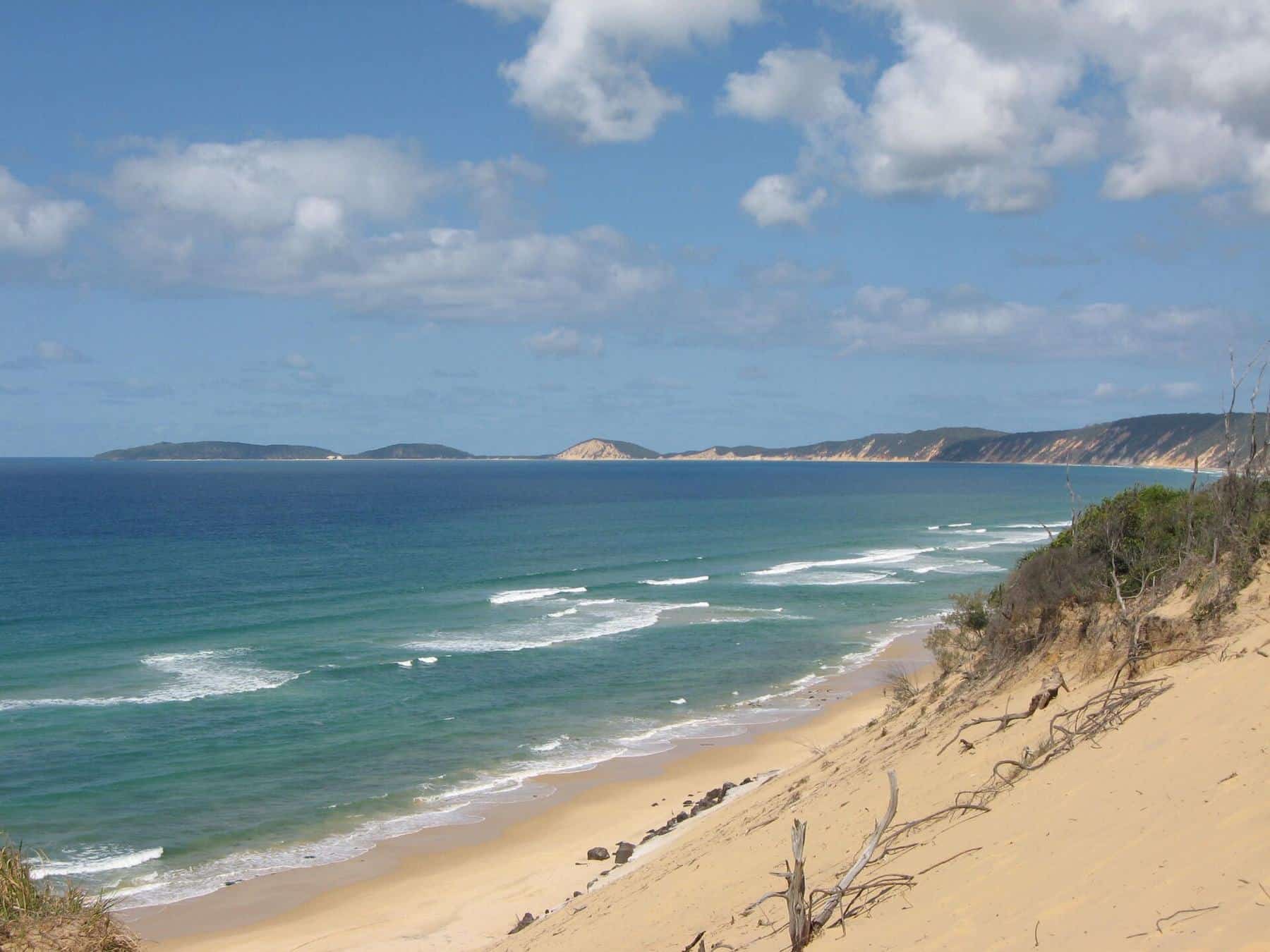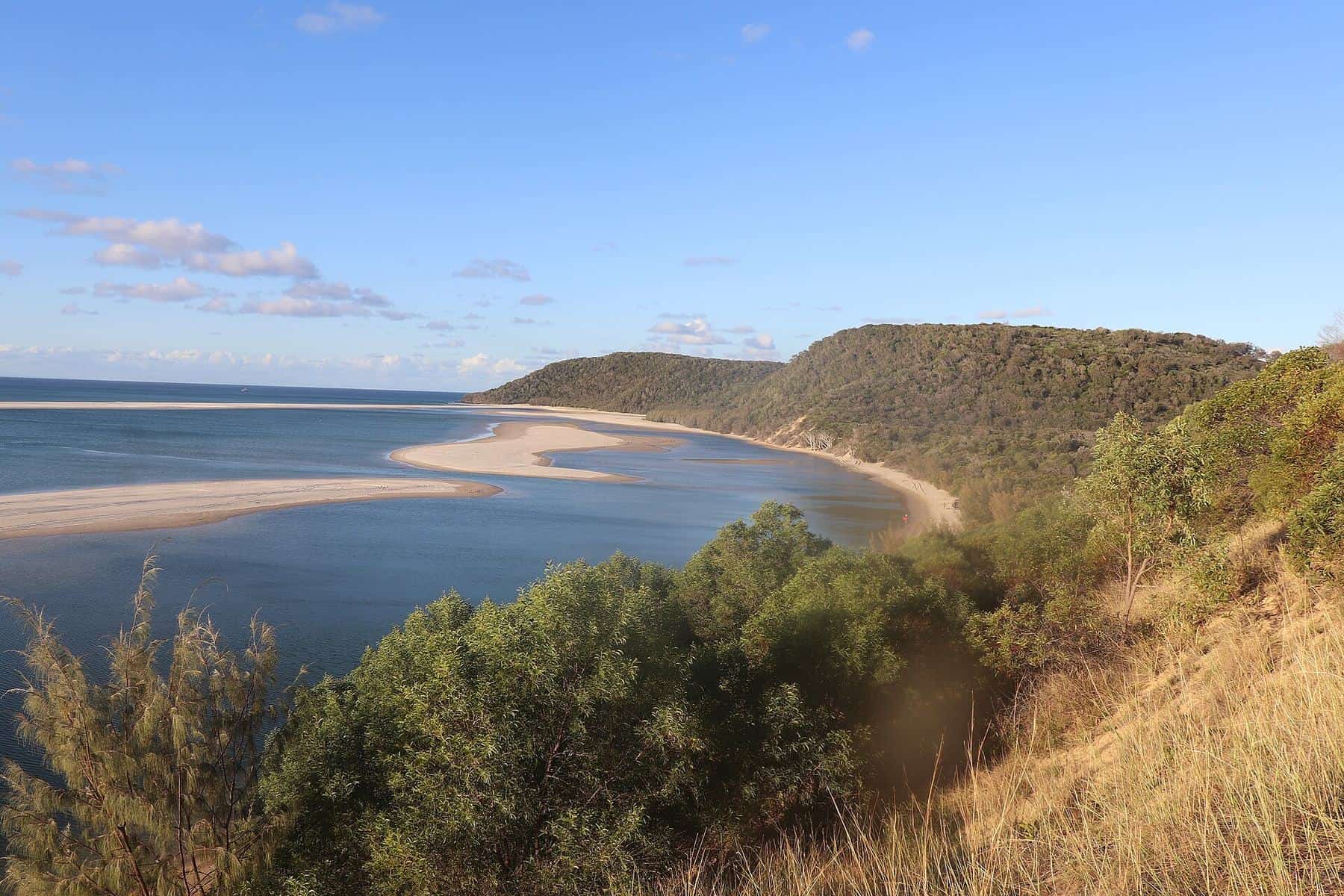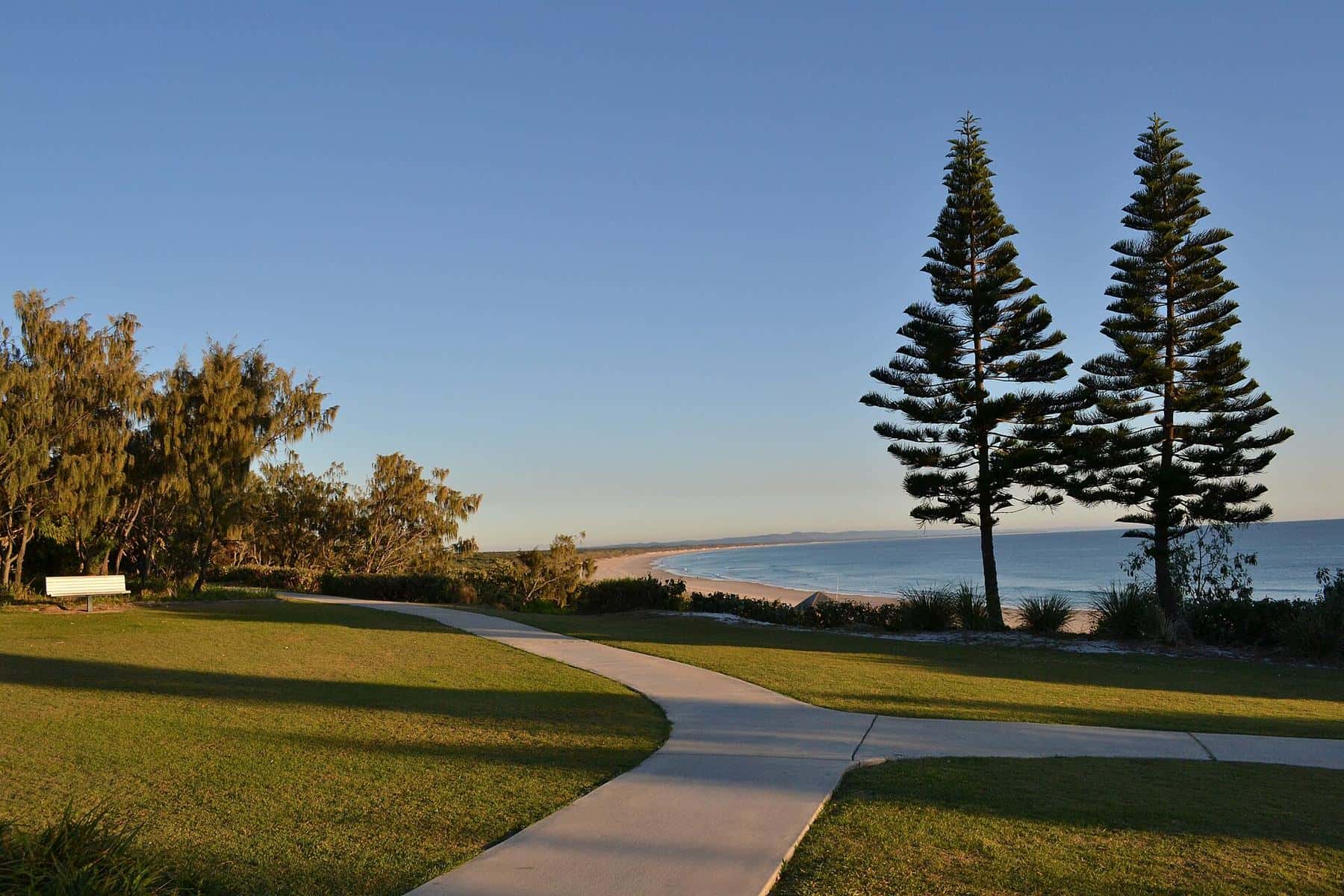
Rainbow Beach looks like a classic Queensland beach town, with a surf club, a main street sloping down to the sand, and holiday apartments on the hill. But its story as a town is short. Until the 1960s there was no road, no power and almost no permanent European settlement here. What changed everything was the black sand beneath the dunes.
1965–76
Sand mining
Mining and processing
1969
Township gazetted
Rainbow Beach
1,220
Population
2021 Census
Kabi Kabi Country
Long before the town, this was, and remains, the Country of the Kabi Kabi people. The coast, lakes and forests provided fish, shellfish, game and plant foods, and middens along the coast record thousands of years of use. The coloured cliffs are part of Kabi Kabi story. In one version, a rainbow spirit named Yiningie fell into the cliffs after a battle, leaving its colours in the sand. Neighbouring K’gari is the Country of the Butchulla people.
Cook, explorers and shipwrecks
James Cook sailed along this coast in May 1770 aboard the Endeavour and named several features. Local accounts trace the name Carlo Point to a member of his crew. Through the nineteenth century, the sandy coast was a hazard to shipping, and in 1884 the Queensland government built the Double Island Point lighthouse to guide vessels entering Wide Bay. Timber-getters worked the forests behind the coast, and the area was reached mainly by sea, along the beach from Noosa, or via rough forestry tracks.
The mineral sands era
After the Second World War, demand grew for the heavy minerals found in black beach sands: rutile and ilmenite, sources of titanium, along with zircon and monazite. Sand mining began on the Gold Coast and northern New South Wales in the 1950s and soon spread north. According to the Rainbow Beach Community News, prospecting on the Inskip Peninsula and south towards Noosa had begun by 1959. Queensland Titanium Mines obtained a lease south of Inskip Point in 1963.
Access was the big problem. The company paid for much of the road and the power supply to the site. Work on its main processing plant, the “dry plant”, began in 1965 near today’s Clarkson Drive, and wet plants that separated the heavy minerals from the sand were floated through the dunes. The Queensland Government records that mineral sand mining and processing at Rainbow Beach ran from 1965 to 1976, and that the dry plant was demolished in 1987.
With workers and families arriving, a town was needed. Rainbow Beach was gazetted as a township in 1969. Local history credits the miners with leaving behind a road, power and an airfield.
From mining town to holiday town
Opposition to sand mining grew in the late 1960s and 1970s as conservationists campaigned to protect Cooloola and K’gari. Mining on K’gari ended in 1976 after a federal decision, and the Cooloola sand mass was progressively added to national park. Rainbow Beach shifted from mining to tourism, attracting fishers, surfers, 4WD enthusiasts and families, and later backpackers heading for K’gari.
The legacy of mining is still being managed. The Queensland Government has run a remediation project at the former processing site north of town, dealing with mineral sand stockpiles, contaminated areas and old plant.
Rainbow Beach today
At the 2021 census, Rainbow Beach had 1,220 residents. The town is in the Gympie Region local government area. Its economy revolves around tourism, with accommodation, cafés, tour operators, dive and surf businesses, and the barge traffic to K’gari. A surf life saving club patrols the main beach, and community groups run markets and events.
The fight for Cooloola and K’gari
The end of sand mining around Rainbow Beach was part of a wider national story. In the late 1960s and early 1970s, conservationists, including the Cooloola Committee and the Fraser Island Defenders Organisation, campaigned against mining in the Cooloola sand mass and on K’gari. They argued that the dunes, lakes and rainforests were globally significant. A federal inquiry into mining on K’gari led to the end of export approvals and the cessation of mining there in 1976. Over the following decades, large parts of Cooloola became national park, and in 1992 K’gari was inscribed on the World Heritage List. Rainbow Beach, a town created by mining, became the gateway to the landscapes that the campaign protected.
Timeline
- Time immemorial: Kabi Kabi Country. The Butchulla people live on K’gari.
- 1770: Cook sails along the coast aboard the Endeavour.
- 1884: The Double Island Point light is first exhibited on 11 September.
- 1963: Queensland Titanium Mines obtains a lease south of Inskip Point.
- 1965: Construction of the dry processing plant begins, and mining starts.
- 1969: Rainbow Beach is gazetted as a township.
- 1976: Mining and processing at Rainbow Beach end. Mining also ends on K’gari.
- 1992: K’gari is inscribed on the World Heritage List.
- 2023: The island’s name is officially restored to K’gari.
Heritage to look for
- Double Island Point lightstation, listed on the Queensland Heritage Register. See our Double Island Point guide.
- The coloured sands and their Kabi Kabi story. See our coloured sands guide.
- Local history displays and community publications, including the Rainbow Beach Community News, which has collected stories from early residents and sand mining workers.
Rainbow Beach heritage checklist
0 of 5 done
Ticks are saved in this browser only.
A note on sources
Much of the early town history comes from local recollections collected by community groups. Where official records exist, such as the Queensland Government’s remediation record and the heritage register, we have used them. If you have a correction or a source to add, please contact us.
Frequently asked questions
When was Rainbow Beach founded?
Rainbow Beach was gazetted as a township in 1969, after mineral sand mining began in the area in the mid-1960s.
What was mined at Rainbow Beach?
Queensland Titanium Mines mined heavy mineral sands containing rutile, ilmenite, zircon and monazite, used for titanium and other industrial products. Mining and processing ran from 1965 to 1976.
What is the population of Rainbow Beach?
At the 2021 census, the locality of Rainbow Beach had a population of 1,220 people.
Who are the Traditional Owners of Rainbow Beach?
The Kabi Kabi (also spelled Gubbi Gubbi) people are the Traditional Owners of the Rainbow Beach and Cooloola area.
Sources and further reading
Facts on this page were checked against these primary and official sources. Conditions change — confirm before you travel or buy.
- Rainbow Beach remediation project — Queensland Government
- Sand mining at Rainbow Beach — Rainbow Beach Community News
- History of Rainbow Beach — Rainbow Beach Community News
- Rainbow Beach, Queensland — Wikipedia (2021 Census)
- Double Island Point Lightstation (Queensland Heritage Register 601722) — Queensland Government